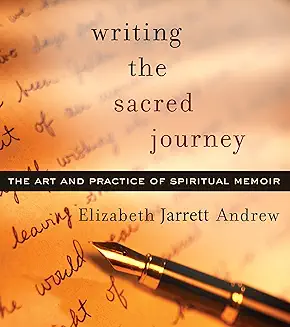
This article is based on the book Writing the Sacred Journey: The Art and Practice of Spiritual Memoir by Elizabeth J. Andrew, published by Skinner House Books, Boston.
Writing the Sacred Journey: Art and Practice of Spiritual Memoir"
This review provides a summary of the key themes, ideas, and practical advice presented in the book "Writing the Sacred Journey: Art and Practice of Spiritual Memoir." The book explores the process of writing a memoir that delves into one's spiritual experiences and growth. It emphasizes authenticity, self-discovery, and finding the sacred in the ordinary.
I. Core Themes:
- Spiritual Memoir as a Journey of Self-Discovery: The book emphasizes that writing a spiritual memoir is not merely recounting past events, but a process of exploring one's inner landscape, beliefs, and relationship with the sacred.
- "Perhaps we write towards what we will become from where we are.”
- "Those who write spiritual memoir write to find out what we believe or, more fundamentally, what we know to be sacred and true."
- Finding the Sacred in the Mundane: The book encourages writers to look for the spiritual in everyday experiences, memories, and even seemingly insignificant details. The act of writing itself can transform ordinary events into something meaningful.
- "Maybe then the problem of identifying the spiritual is simply a subtle one requiring a sharp eye and a talent for reading the resonance of events."
- "I also see that extravagant yawn as a window into another life, a bored adult’s life, and I have complete freedom to imagine the circumstances surrounding it. It’s a mundane, quirky anecdote. But if I treat it with reverence, I find holiness in the clarity and humor and in my youthful conviction that the image was worth retaining."
- The Importance of Authenticity and Honesty: Writers are urged to be truthful in their portrayal of themselves and their experiences, even when it involves confronting difficult or uncomfortable truths. The book suggests ways to explore "lies" or embellishments in early drafts to uncover deeper emotional truths.
- "When memoir writers are responsible to the story, they honor that which is vital and true—the spirit—within their experience."
- "It is, however, a good policy to be honest about your dishonesty."
- The Power of Story: The book underscores the significance of personal stories, even if they are not extraordinary. It emphasizes that everyone's experience is unique and valuable, and that sharing these stories can connect with others and reveal universal truths.
- "Each of us is a concentrated universe; each of us mirrors eternity. Books and stories demonstrate this amazing phenomenon."
- "The universe is made of stories, not atoms."
- Revision as a Process of Deepening Understanding: Revision isn't simply about correcting grammar or polishing prose; it is about revisiting memories, exploring their layers of meaning, and gaining deeper insight into oneself and one's spiritual journey.
- "If memories are sacred stories and our means for discerning holiness in the world, then revision is a form of meditation or prayer."
II. Key Ideas & Facts:
- Writing for the Story Itself: The true motivation for writing should stem from a compulsion to tell the story, rather than external factors like seeking fame or pleasing an audience.
- "But there is a third, more subtle answer—one that is at the source of your drive and conviction: “I write for the story itself.”"
- Living the Questions: The book emphasizes the importance of exploring questions, rather than seeking easy answers. The process of questioning can be more valuable than finding definitive resolutions.
- "What makes a good memoir is the search, not the resolution."
- "Live the questions now. Perhaps you will then gradually, without noticing it, live along some distant day into the answer."
- The Writer's Journal: Keeping a journal is recommended as a space for exploring ideas, memories, and emotions without judgment or pressure. It serves as a "dumping ground for false starts" and a place to confront writer's block.
- The Significance of the Body: The body is presented as a vessel of memory and wisdom. Attending to physical sensations and bodily experiences can unlock deeper insights and ground the story in reality.
- "Bodies carry our immediate history and our heritage; they too are made of stories."
- Dreams as Scripture: Dreams are described as a unique form of personal scripture, containing messages and insights that can aid in healing and self-understanding.
- "Every dream is a story uniquely crafted for you and no other; each dream, no matter how disturbing, works for your healing."
- Honoring Teachers (Internal and External): Recognizing and honoring the people or experiences that have acted as teachers on one's spiritual path is crucial. These figures can serve as containers for the author's story.
- "Essentially this is the literary role the teacher-character plays in every spiritual memoir. The teacher is a vessel that, for a period of time, shapes and holds the author’s story."
- Spiritual Geography: Place and setting play a vital role in shaping one's identity and spiritual journey. Describing the landscapes of origin can reveal deep connections and influences.
- "Nearly twenty years ago I returned to the holy ground of my childhood summers; I moved from New York City to the house my mother had grown up in, in an isolated town on the border between North and South Dakota. More than any other place I lived as a child or young adult— Virginia, Illinois, Hawaii, Vermont, New York—this is my spiritual geography, the place where I’ve wrestled my story out of the circumstances of landscape and inheritance."
III. Practical Advice & Exercises:
The book includes a multitude of practical exercises to help writers explore their memories, develop their voice, and craft compelling narratives. Examples include:
- Listing Life's Grand Questions: Identify and reflect on the significant questions that have shaped one's life.
- Mapping the Spiritual Journey: Visually represent one's spiritual journey, marking landmarks, turning points, and significant memories.
- Writing "Lies" to Uncover Truth: Explore imaginative embellishments to reveal deeper emotional truths.
- Describing a Game from Childhood: Reflect on the symbolism and meaning of childhood games to understand essential nature.
- Describing a Difficult Memory in Third Person: Shift perspective to gain distance and clarity when writing about challenging experiences.
- Writing Digressions Intentionally: Allow the mind to wander and explore seemingly unrelated memories to uncover deeper insights.
IV. Cautionary Notes:
- Beware of Clichés: Avoid relying on generic or overused language when describing spiritual experiences.
- Don't Condescend to Your Younger Self: Treat past selves with respect and understanding.
- Avoid Too Many Questions: Too many questions can diffuse the story's focus and create anxiety for the reader.
- The importance of Details: Include details that "do the work of the piece" grounding the reader, evoking emotions, and revealing the story's heart.
V. Concluding Thought:
The book suggests that the true reward of writing a spiritual memoir lies not in publication or recognition, but in the process of self-discovery and integration. By confronting memories, exploring beliefs, and finding the sacred in the ordinary, writers can gain a deeper understanding of themselves and their place in the world.
"Our stories reveal holiness."