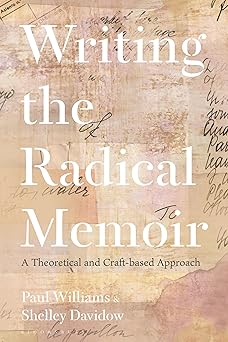
by Paul Williams and Shelley Davidow - available from Bloomsbury Academic
The book "Writing the Radical Memoir" explores the concept of memoir writing beyond a simple recounting of events. It emphasizes:
- Uniqueness and Experimentation: Every memoir is unique because every life and perspective is unique. The book encourages experimentation with form, style, and genre.
- "There are as many ways to do something new as there are humans who do them...encourage you to throw caution to the wind, be wild and unfettered in your affair with words and the way you turn your life into art."
- Subjectivity and Truth: Memoir is not about objective truth but about the felt truth of an experience. It's about your perspective and interpretation.
- "It is in the perception of events, and not in the events themselves, that the truth of the experience emerges."
- The Reader/Writer Contract: This central concept highlights the implicit agreement between memoirist and reader: The author strives for honesty and authenticity, even while acknowledging the limitations of memory and perspective.
- "Personal memory is a limitless resource for story material... staying true to this contract with your reader: this is what it felt like to be that person living through that experience – this is what happened for me."
- Memory as Reconstruction: Memories are not static recordings but are constantly being reshaped and reinterpreted by the present.
- "As discussed, memory retrieval is not simply getting fixed data that is stored somewhere, like a file we can access and read... memories are not static. They are changed and re-written depending on where we stand in the present."
- Radical Honesty & Self-Examination: The book encourages unflinching honesty, even when it's uncomfortable, and pushes writers to examine their biases, prejudices, and the societal influences that have shaped their perceptions. This includes acknowledging privilege and the potential for harm in representing others.
- "A radical memoir asks us to step back and look at ourselves not in isolation but how we are in relation to our society."
- Ethical Considerations: Writing about others requires careful consideration. The book raises questions about the memoirist's right to tell other people's stories, the potential for misrepresentation, and the impact on those involved.
- "In my darkest moments I feel as a memoir writer like a literary cannibal – am I at some level consuming the people in my life and history, leaving behind in the public sphere, avatars of the people in my life that I have constructed?"
- Genre-Bending and Deconstruction: "Writing the Radical Memoir" advocates for breaking free from traditional memoir conventions. This can involve experimenting with form, incorporating other genres (poetry, fairy tales, etc.), and deconstructing the very notion of a stable "self."
- "Since writing a memoir is a [re]construction of identity that offers the opportunity to push back against traditional structures and draw on other genres, could a life-story be made up of a pastiche of other narratives?"
- Writing as Therapy: The act of writing and retelling stories can be transformative, providing new ways to understand the world and frame impactful events.
- "In telling our stories, we reframe our narratives. As writing teachers and authors we know the therapeutic power of telling and retelling stories. It has been our experience that focusing on particular themes and going to their depths has helped us see our lives in completely new ways."
II. Key Ideas and Exercises
The book offers practical exercises and concepts to facilitate radical memoir writing:
- Freewriting: Use prompts to bypass the inner critic and tap into raw thoughts and feelings. Example: "I want to write a memoir, because..."
- Photographic Realism: Analyze a significant photograph to unlock memories and explore their emotional resonance.
- Example: The author analyzes a photo from Rhodesia, revealing details about his youth, repressed desires, and the social context.
- Happiness Index Graph: Chart your emotional life on a graph to identify pivotal events and patterns.
- Freytag's Pyramid: Understand narrative structure and plot the course of your life story using this model.
- Ultimate Quest: Frame your life as a hero's journey, identifying your quest, powers, mentors, adversaries, and "grail."
- Disclaimer Exercise: Write a disclaimer to liberate yourself from constraints and expectations.
- Creating Characters: Develop real people into compelling characters through dialogue and descriptive details.
- "Write a scene from your life (300 words) and at the centre of this, create a piece of dialogue between you and one of your ‘characters’ or between people you know."
- Bursting the Bubble: Contrast a domestic event with the broader political context of the time.
- Your Life as a Haiku: Condense your experiences into this poetic form.
- Playing with Form and Genre: Experiment with non-traditional structures, such as writing in columns or incorporating elements of horror, romance, or fairy tales.
- Autobiographics: Write about yourself from another point of view (a lover, friend, enemy) to challenge fixed notions of "self."
- Other Voices Exercise: Define a particular event in your life using multiple voices (mother, eulogy, newspaper clipping, diary entry, etc.).
III. Theoretical Framework
The book draws on various theoretical frameworks to inform its approach to memoir:
- Narrative Psychiatry (Lewis Mehl-Madrona): Internal narratives shape our lives and can be shifted over time.
- Maslow's Hierarchy of Needs: Understand the driving forces behind your story by considering your characters' (and your own) needs.
- Derrida's Deconstruction: Examine the constructed nature of reality and the "self" to uncover hidden structures and challenge assumptions. ("There is nothing outside the text.")
- Lacan's Méconnaissance: Recognize that the "self" is a misrecognition, a constructed illusion.
- Lyotard's Grand and Petit Récits: Be wary of grand, all-encompassing narratives and embrace the value of smaller, more personal stories.
- Gilmore’s Autobiographics: Understand “I” or the “self” is not an unproblematic unified, timeless “me” but needs to reflect ‘the shifting sides of identity’.
IV. Examples from the Authors' Own Work
The authors, Paul Williams and Shelley Davidow, provide examples from their own memoirs to illustrate the concepts discussed. These include:
- Paul Williams' Soldier Blue: Deconstruction of his experiences in the Rhodesian army.
- Shelley Davidow's Eye of the Moon and Whisperings in the Blood: Exploration of identity, memory, and the complexities of growing up in South Africa during Apartheid.
- Shelley Davidow and Shaimaa Khalil's Runaways: a collective memoir and exercise of two voices.
V. Overall Message
"Writing the Radical Memoir" encourages writers to be bold, honest, and experimental in their approach to memoir writing. It emphasizes that memoir is not just about recounting the past but about understanding and re-creating the self through the act of writing. The book promotes a critical and ethical approach, urging writers to consider the impact of their work on themselves and others. The overall aim is to discover who you are and put the story into a narrative form.
Memoir is not just about recounting the past—it’s about shaping a narrative that reveals something deeper, both to the writer and the reader. It’s a creative act that demands honesty, structure, and sometimes a willingness to challenge traditional storytelling. Writing a memoir, particularly a radical one, means stepping beyond conventional boundaries to interrogate memory, identity, and the forces that shape our lives.
Two Paths to the Final Work
Writers typically take one of two approaches when developing a memoir: learning from authority or drawing from personal experience. The best writing often blends both. You study craft, read great memoirs, and absorb narrative techniques. At the same time, you experiment, freewrite, and discover your own voice through lived experience. The balance between structure and intuition is what brings a memoir to life.
Memoir as Photographic Realism
A memoir functions like a photograph, capturing a particular moment or emotional truth rather than an exhaustive account of everything that happened. Just as a photographer selects framing, light, and focus, a memoirist chooses what to highlight and what to leave in the shadows. It’s about revealing the essence of a moment rather than documenting it with rigid accuracy.
Mapping Your Life with a Happiness Index
A useful way to start structuring a memoir is to chart the emotional highs and lows of your life. A "happiness index" helps identify pivotal moments—periods of joy, despair, transformation. Mapping these points allows patterns to emerge, guiding you toward the deeper themes that shape your story. This method helps uncover connections between events that might otherwise seem unrelated.
Narrative Structure: Freytag’s Pyramid
Memoir, like fiction, benefits from a strong narrative arc. Freytag’s Pyramid is a classic story structure that outlines key plot points:
- Introduction: Establishes the setting and characters.
- Inciting Incident: The moment that sets the memoir’s main events in motion.
- Rising Action: A series of events that build tension.
- Climax: The emotional or thematic peak of the story.
- Falling Action & Denouement: The resolution and reflection on the journey.
A compelling memoir doesn’t just list events; it builds momentum, leading the reader through a transformative experience.
The Power of Internal Narratives
Dr. Lewis Mehl-Madrona, a psychiatrist and narrative medicine expert, suggests that our internal stories shape how we experience life. These narratives, often deeply ingrained, become neurological patterns that influence our thoughts and behaviors. Memoir offers an opportunity to examine and even rewrite these personal myths, shifting our understanding of ourselves.
Memoir as a Decolonial Act
Writing a memoir isn’t just a personal exercise—it can be an act of resistance. A decolonial memoir challenges dominant narratives, placing personal experience within broader social and historical contexts. Instead of presenting the self as an isolated individual, this approach examines how identity is shaped by external forces such as culture, politics, and inherited histories.
Using Haiku in Memoir
A Haiku—a short poem with a 5-7-5 syllable structure—can be a powerful tool in memoir writing. It forces the writer to distill a moment into its purest essence. Haiku can punctuate a memoir, offering brief, lyrical reflections that contrast with longer narrative passages.
The Impact of Parataxis
Parataxis—the placement of words or phrases side by side without conjunctions—creates a fragmented, collage-like effect in writing. This technique allows a memoirist to present a series of images or moments without explicitly linking them, letting the reader draw connections. It mimics the way memory often works—flashes of experience rather than a continuous flow.
Derrida’s Challenge: "There Is Nothing Outside the Text"
Jacques Derrida’s idea that "there is nothing outside the text" suggests that language doesn’t just describe reality—it constructs it. This challenges the traditional notion that memoir is a direct reflection of truth. Instead, memoir is an act of creating the self through storytelling. Every choice—the words, the structure, the omissions—shapes the identity being presented.
Autobiographics: Memoir Beyond the Singular Self
Feminist scholar Leigh Gilmore coined the term autobiographics to critique the idea of a singular, unified self in autobiography. She argues that identity is fluid, full of contradictions and interruptions. A radical memoir embraces this complexity, resisting the urge to present a polished, coherent version of the past. Instead, it welcomes shifting perspectives, gaps in memory, and moments of resistance.
Ethical Considerations in Memoir
Writing about real people comes with ethical responsibilities. Memory is subjective, and perspectives differ. How do you tell your truth without distorting someone else’s? How do you navigate the tension between honesty and compassion? Memoirists must consider the impact of their words, balancing personal expression with ethical awareness.
Radical Memoir: Breaking the Mold
Traditional memoirs often follow familiar structures, focusing on personal transformation within a linear narrative. A radical memoir, by contrast, pushes boundaries. It experiments with form, incorporates multiple voices, blends genres, and questions the idea of objective truth. This approach can be challenging, but it allows for a richer, more nuanced exploration of personal and social identity.
Memory and Its Distortions
Memory is unreliable. It shifts over time, influenced by new experiences, emotions, and even the act of remembering itself. A memoirist must acknowledge this fluidity. Rather than striving for absolute accuracy, a compelling memoir embraces the gaps, contradictions, and subjectivity inherent in recalling the past.
Narrative Techniques in Memoir
Different techniques can add depth to a memoir:
- Parataxis: Creates a fast-paced, image-driven narrative.
- Multiple Perspectives: Offers different angles on the same event.
- Genre-Bending: Blends memoir with essay, poetry, or theory to expand its scope.
These techniques break from traditional storytelling, making room for a more layered and emotionally resonant narrative.
The Therapeutic Power of Memoir
Writing a memoir isn’t just about telling a story—it can be a transformative process. It allows writers to reframe their past, make sense of trauma, and gain new insights. By reshaping personal narratives, memoirists can shift their internal stories, sometimes even altering their relationship to past experiences.
Final Thoughts
Memoir is more than a recounting of events—it’s a construction of self, a challenge to established narratives, and a space for deep reflection. A radical memoir takes this even further, questioning conventions, exploring new forms, and positioning personal stories within larger cultural and political frameworks. Whether traditional or experimental, memoir is a way of making meaning from experience—and in doing so, shaping the way we see ourselves and the world.
Practical Exercises
- Freewrite: 'I want to write memoir, because …' Set a timer for two minutes and write continuously without stopping, paying no attention to grammar, spelling, or punctuation. The goal is to explore your motivations for writing a memoir.
- Photographic realism: Find a photograph of yourself that holds significance. Describe the photo in detail, including the setting, people, and your feelings at the time. Then consider the following questions:
- What did you learn about yourself by doing this exercise? Sum up who you are and who you were. Have you changed? How? Why? What point could you make about yourself here? What did you focus on? Is there a theme? Write a paragraph analyzing this.
- Destabilizing memory: do you think there are any inaccuracies in how you have described yourself/this event/these people? Any biases you have or had? Write a short paragraph discussing this. This exercise encourages you to analyze a moment in your life and consider potential biases in your memory.
- The Truth Is…: Search for your digital self online and write a 150-word paragraph about yourself based on that information. Then, write another paragraph starting with "the truth is…" providing details that may contradict what you found online. This exercise highlights the difference between online representation and personal truth.
- Speed Dating: Create two dating profiles of yourself, each 250 words long. In the first, present yourself in the most attractive light, and in the second, be searingly honest about your faults. Include a photo for each profile. Reflect on the effect of these two versions side-by-side and consider if this could be a useful literary device in your memoir. This exercise encourages you to explore different facets of your identity.
- Happiness Index Graph: Create a graph of your emotional life with "time" (from age three to now) on the x-axis and "happiness" on the y-axis. Plot pivotal events on the timeline, use these events as headings, and write rough notes about each one. Then reflect on any revelations or insights into the pattern of your life and consider if there is a story there. This exercise helps you visually map the emotional trajectory of your life.
- Every Character Wants Something: Write a 200-word paragraph about an intrinsic need, describing an event or incident that reflects you trying to find someone, to be loved, heard, fed, seen, to succeed, or be yourself. This exercise encourages you to explore your core desires and motivations.
- Core Wounds: Write a short scene where you reveal a 'core wound' through dialogue, action, or thought, without explicitly stating the emotion. Consider themes like abandonment, unrequited love, regret, or guilt, and use sensory detail to illuminate the sentiment. This exercise focuses on showing, not telling, to reveal deep emotional scars.
- Your Ultimate Quest: Answer the following questions to identify the themes in your life:
- What journey/quest are you on?
- What powers do you have?
- What mentor will help you?
- What adversity are you struggling against?
- What/who is your nemesis?
- What threshold experiences do you face?
- Who/what is your ‘grail’? This exercise uses the framework of a hero's journey to help you reflect on your life's purpose and challenges.
- Disclaimer: Write a fifty-word disclaimer for the memoir you are writing or will write. Be humorous, ironic, or serious, and write something that sets you free to do what you will be doing. Remember that you can change this several times once your memoir is complete. This exercise encourages you to define your approach to truth-telling in your memoir.
- First Memory: Using as much sensory imagery as possible, write out your first memory in a paragraph of 300 words. Recall what it was like to be that age: what did you hear, smell, taste, feel, think, and see? Then, consider why this memory is significant and its relation to the rest of your life or memoir. This exercise aims to uncover the roots of your identity through early sensory experiences.
- Cued Recall: Write for six minutes about Tuesday, October 29, 2005, at 3 p.m.. To start, consider what you were doing that year, where you lived, what work you were doing, who was in your life, what you usually did on Tuesday afternoons, and what the weather was like.
- Free Recall: Write without stopping for five minutes about a song, a smell. This exercise is designed to practice and exercise memory recall.
- Multi-Sensory Scene Building Using Dreams: Write a descriptive paragraph (300–500 words) that brings a sensory experience from a dream to life. Focus on sight, smell, touch, sound, and taste, and recreate the details and the corresponding emotion. Show the impact of that experience/dream and how it inscribed itself into your memory. This exercise taps into the unconscious mind to enrich your memoir with surreal and emotional depth.
- Creating Characters Out of People You Know: Write a 300-word scene from your life with dialogue between you and one of your 'characters' or between people you know. Describe the setting and the characters with brief 'brushstrokes'. Allow the dialogue to reveal who these people are, and ensure you place a statement or some words that you actually said/heard somewhere in the dialogue. Build the interaction around that. This exercise focuses on capturing the essence of real people through dialogue and brief descriptions.
- Remember This: With a family member or friend, discuss incidents in the past that you both remember, involving the two of you. Select one incident, and each person should write a 300–500-word paragraph that captures what happened and describes each person from the other’s point of view. Share with each other and discuss the discrepancies. This exercise highlights the subjective nature of memory and perspective.
- Life into Art: Create a scene (300 words) from the past involving friends or family members. Include dialogue, description, and/or mannerisms that particularly identify them. As a reflection, consider how those people might feel about the passage on them. Would they agree with your rendition of them/the situation, and why/why not?
- The Political Is The Personal: What political, social, economic, religious, gender-related or racial forces or expectations shaped your identity, and how did you respond to these forces? Were you aware of them, or did you awaken to them later? Did you accept them or resist them? Write a short scene (300 words) where you show the subtle forces of others’ expectations on your life using the above as an example.
- Your Life as a Fairy Tale: Write the beginning of your life as though you were writing a fairy tale, starting with "Once upon a time there was a little boy/girl/princess/troll called …". This should be a five-minute exercise.
- Magic Realism: Write a 300-word paragraph/segment of your life as a magical realist piece. Describe magical things as if they are everyday occurrences. Add magical elements into your life-story without making excuses for them or relegating them to the realm of dream/fantasy/vision and see what happens.
- Text Messages: Write a section of your life as a series of text messages that reveal what’s going on and some tension between the ‘characters’. Use a real conversation or parts of a real conversation if it suits you.
- Parataxis and Stream-of-Consciousness: Write a 300-word paragraph about your life using parataxis to create a stream-of-consciousness effect. Place the same emotional weight on each element, or build a collection of different items, ideas, or experiences that have the same ‘weight’.
- Hypotaxis and Emotional Build-Up: Write a 300-word paragraph about your life using hypotaxis and create a build-up of emotions or different ideas that stack on each other incrementally.
- Playing with Form and Genre: Write a page of your memoir by experimenting in form. Either write in several columns, each column representing different aspects of yourself, or different times, moods, and places in your life, or break the form even more, disrupting the linear flow of narrative across the page, using patterns and gaps to create the story.
- Beginnings: Write a 300-word beginning of your memoir, starting at a tense or action-packed moment, in medias res, an exciting episode you take from later in the memoir – the most exciting or tense part of your story. Don't give us the whole scene, just a teaser, a taste, a foreshadowing of what is to come. Read this to someone and ask if they would read on.
- Emotional Truth: Write a 300-word scene from your past that was intensely memorable and describe it as you feel it was, not necessarily as it happened. Create dialogue that may not be exact but that conveys the spirit of what was said.
- Two Selves: Write a 300-word paragraph about an incident where you returned to a place from the past – your old country, house, or school. Describe the experience of the current reality, superimposing it on how you experienced it in the past and how it looked back then. Map the emotional distance between then and now.
- Other Voices – Alone or With Others: Write three or more paragraphs that define a particular event in your life, such as an accident, a wedding, or a pivotal moment. Use a different voice for each of these paragraphs, such as your mother telling the story, a eulogy, a report, a newspaper clipping (real or created), or your own diary entry. If you have a partner to write with, a sibling, or a close friend, give them the task of writing one of those paragraphs to juxtapose with yours.
- The Power of Two Voices: This exercise takes two partners. Step 1: write for seven minutes a scene from the past in which you both feature. Do not consult each other or plan what to write. Step 2: Share what you have written. Read the example from Runaways.
- An Astonishing Fact – Autrebiography: Write a paragraph of 200 words about an incident that happened more than ten years ago, using ‘I’ (first person). Then rewrite the same passage in the third person. Note the difference and distance this creates, and decide which one you prefer and which one reflects the emotional truth of the incident better.
- Unflinchingness: Write a 300-word paragraph about an incident in your teens. Somewhere in the piece, present a reflection, as per the examples above, on the distance between that past self and the present self who is now writing the paragraph. Be as ‘unflinching’ as you can, but be forgiving too!
- Truth or Lie: Write three things about yourself, one of which is a lie (a fiction). Share with a partner or writing group and ask them to guess which is the truth (autobiography) and which is the lie (the fiction), making the lie about yourself as convincing as possible.
- Autobiografiction: Write a 300-word paragraph about yourself that may or may not be true, or it may have some truth. It could be a story someone else has told about you, or one you invented, a lie you told once about yourself. You can also add a reflection on how this self and story has been constructed.
- Petit Récit: Write a 300-word anecdote, fragment, or small incident from your life that stands alone. It may not fit in with any theme you have uncovered and may not even make sense to you, but it happened and it has some significance.
- Biographemes: Write three 'biographemes', three short 100-word 'petits récits' that are unrelated memories. These could be anecdotes, fragments, or small incidents.
- Transmedia: Add to your 'biographemes' and the first 'petit récit' you wrote some fragments of your past self, such as a photograph, an old letter, a text message, or a drawing you did as a child. Rearrange these fragments in random order to make a collage of your past self that others can read.
- Méconnaissance: Imagine you are attending your own funeral. What would others say about you? Write a few short paragraphs, each one by an imagined friend, family member, or work colleague, and allow for contradiction in this pastiche.
- Portfolio – Your Radical Memoir: Collect and collate all the exercises in this book, including the photographs, graphs, and experimental forms, and create a portfolio of these fragments. Arrange them in whatever order you want and format them. Give the memoir a title, and perhaps you now have a first draft.
- Final Naked Freewrite: Using the title ‘The Root of Things’, write without stopping for five minutes about the root of things – whatever that means to you. Don’t worry about spelling or grammar, just go – experiment. Be poetic, be random, and have no boundaries in form or content. Be angry, be sad and be joyful. Write as if no one will read this. When you are done, read over what you've written.
By engaging with these exercises, you'll not only generate material for your radical memoir but also gain a deeper understanding of yourself and the art of crafting a compelling narrative.